Schools + Policies
Understand how policies shape opportunities and experiences at the school level.
Momentum regularly collects and updates the School, Policy, and Performance Database as the foundation for all of Momentum’s research and policy efforts.
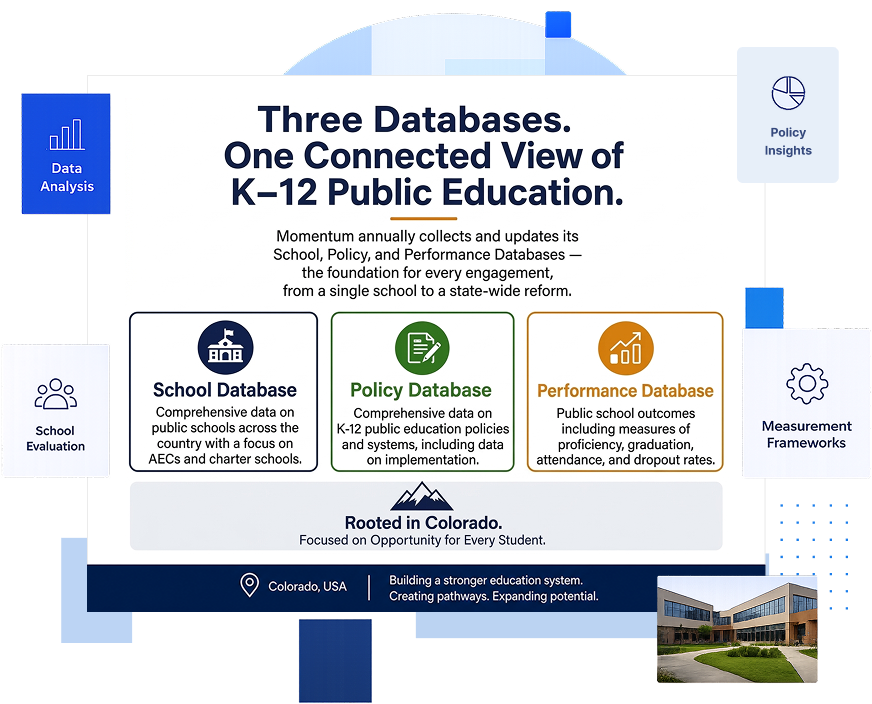
Each database stands on its own — but every Momentum engagement draws on all three. The intersections are where the most useful insights live.
School-level data on enrollment, programs, and student outcomes.
State K-12 policies related to alternative education, and charter school operations, authorizing, funding, and facilities access.
School outcomes across the major accountability system indicators
Understand how policies shape opportunities and experiences at the school level.
Connect school-level data with outcomes to identify what is working and where.
See how policies influence performance across states and schools.
When school, policy, and performance data intersect, we uncover insights that drive meaningful change.

A comprehensive list of public schools, their locations, and enrollment data — with a focus on alternative education campuses (AECs) and charter schools.
Identify comparison schools for school evaluations
Map enrollment trends
Map performance trends (combined with the Performance Database)
Number of K-12 students enrolled in public education (NCES 2025).
The percent of public school students enrolled in charter schools.
The percent of public school students enrolled in alternative schools (stand-alone public schools only).
Momentum's one-of-a-kind performance database on alternative schools alone, updated annually from public data sources to inform policy and practice for this highly specialized group of schools.
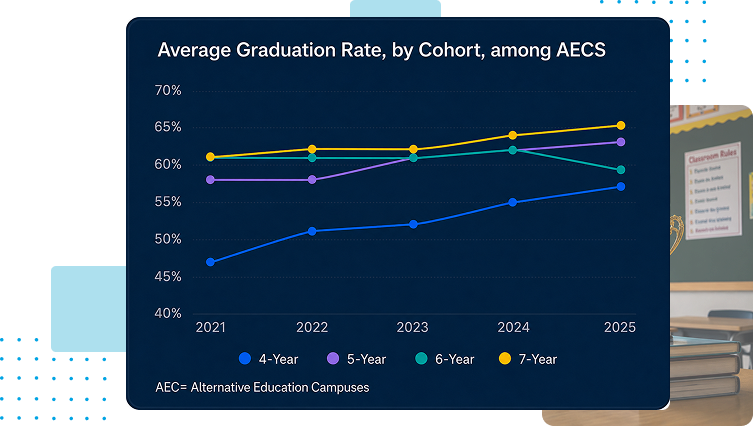
Cohort graduation rates (4 through 7-year)
Proficiency rates on statewide assessments
Attendance metrics — ADA, chronic absenteeism, truancy, stability, mobility
Event and cohort dropout rates
College readiness assessment outcomes
Number of alternative public schools in the US (standalone schools only)
Percent of public schools that are alternative schools.
approximate number of students enrolled in an alternative school in the fall of each school year.
Momentum’s policy database includes a growing list of policies related to public education across the country, and allows us to provide our partners with state and national-level policy scans, and creates a pool of policies from which we can pull to assist advocacy organizations and policymakers to improve policies across a number of areas, including (but not limited to):
Alternative education policies and systems
School accountability policies and systems
Charter school related policies, including facilities and funding
State and federal public education policies
Publicly available school performance data, collected annually from state departments of education — feeding local, state, and national trend analysis.
How can our data help you?